
Is PlayinMatch Safe? The ₹50,000 KYC Line and a Real Answer
Yes, within limits you can test yourself. PlayinMatch guards an account with three rules: a one-time code on every new device, payouts only to a bank or UPI in your own name, and KYC paperwork only after cumulative withdrawals pass ₹50,000 (what happens to those documents is set out in the PlayinMatch privacy policy). What it does not show is an Indian licence, and the reason sits further down.
Easy PlayinMatch Sign-In, With a Code on Every New Phone
The first time this ID opens on a phone or browser browser it has never seen, PlayinMatch sends a one-time code before the balance appears.
PlayinMatch Review Searches: Safe, Real or Fake, Legal in India
Is PlayinMatch safe, in a few lines
Someone typing is playinmatch safe into a search bar usually wants one of two answers. Does the money come back out, and can a stranger walk into the account? PlayinMatch handles both with mechanics rather than badges: a code for each new device, payouts that land only in a same-name account, and KYC that starts once total withdrawals reach ₹50,000.
Those three rules carry this whole page. The six checks further down test each one against how a PlayinMatch account behaves day to day.
PlayinMatch real or fake, and what a review should weigh
Searches for playinmatch real or fake tend to follow a worrying forum thread. A fair playinmatch review separates two claims. One: PlayinMatch issues IDs, takes deposits and pays out inside its published limits, which is true. Two: the company behind it says very little about itself, which is also true. Both can stand at once, and the verdict below weighs them against each other.
PlayinMatch legal in India, short form
The playinmatch legal in india question has no single national answer, because betting in India is largely a matter for each state.
Some states prohibit online betting outright; others have no specific rule. Read the legal section before a first deposit, and check where your own state stands today rather than trusting what a two-year-old article claimed.
- is playinmatch safe
- playinmatch review
- playinmatch real or fake
- playinmatch legal in india
- is playinmatch real
- playinmatch safe or not
- playinmatch fake hai kya
- playinmatch kyc limit
Six Real PlayinMatch Safety Checks, Each Tied to a Rule You Can Test
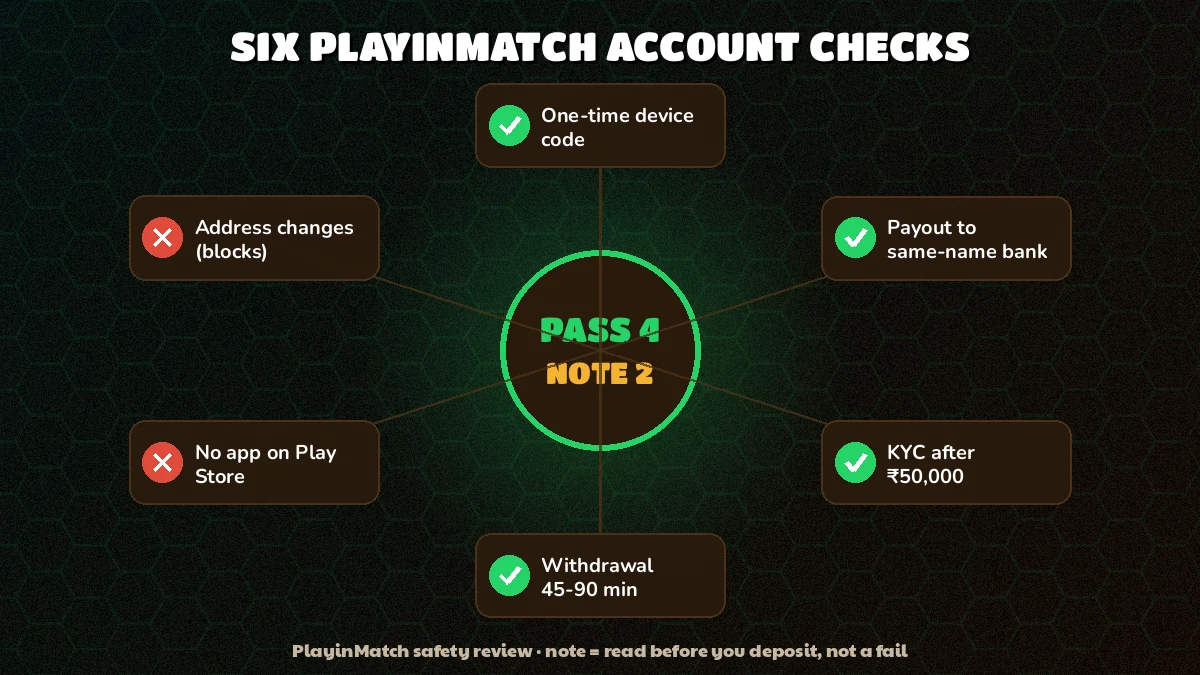
A safety claim is only worth something if you can poke at it. So instead of a score out of ten, here are six things PlayinMatch actually does with an account, each marked pass or note. A pass means the system enforces the rule every single time. A note means it depends on a clock or on people, and people have busy evenings.
- Same-name payoutPass
- New-device codePass
- ₹50,000 KYC linePass
- Payout clockNote
- Desk replyNote
- Address changesNote
- Same-name payout: pass
- Before any rupee leaves, the PlayinMatch cashier asks one question: is the receiving account in the same name as this ID? Sounds like paperwork. In practice it is what turns a leaked password into a nuisance rather than a loss, since whoever gets in can at most place bets with your balance; they cannot pull it out to a handle of their own. Most bounced requests trace to a small gap, like "R. Sharma" on the bank side against "Rohit Sharma" on the ID.
- New-device code: pass
- Every new phone or new browser gets a one-time code before PlayinMatch shows the balance. Your usual handset in the same browser: no code. A cousin's laptop on a Sunday: code. People find it mildly irritating on day one and forget about it by day three. If the code never turns up, the PlayinMatch login steps cover the error screens and what to try next.
- ₹50,000 KYC line: pass
- No documents at sign-up. None. PlayinMatch asks for identity papers once your total withdrawals, added up across the life of the account, cross ₹50,000. A worked example: you have taken out ₹42,000 over a few months and now request ₹12,000 more. That pushes the running total to ₹54,000, so this is the payout where the desk asks for documents. Stay below the line and there is no paperwork at all. Some read that as lax. It is closer to proportionate.
- Payout clock: note
- A withdrawal on PlayinMatch is a request, not a transfer that fires the second you tap it. The published window, the minimum amount and the daily cap on requests are all laid out on the PlayinMatch withdrawal time page. Marked as a note only because a window is a range, not a promise to the minute.
- Desk reply: note
- Disputes go to a human desk on WhatsApp, not a ticket form that disappears into a queue. The typical first-reply time and the unblock, OTP-reset and complaint routes sit with PlayinMatch customer care. A human desk is quicker then a form on a quiet afternoon and probably slower on a big match night, so plan around that.
- Address changes: note
- The address risk is a fake, not a move. A copycat sign-in screen on a domain PlayinMatch never used will ask for your password and keep it. Genuine moves happen too (Indian internet providers block betting domains now and then, which pushes PlayinMatch onto a new one), but those carry your ID and balance across untouched. Which brand variants belong together is laid out on the PlayinMatch99 address page.
You do not need to take any of this on trust. Four quick tests on your own PlayinMatch account cover the ground, and none of them needs a big deposit.
- Sign in once from a browser you have never used for PlayinMatch, say a laptop at home. A code prompt should appear before the balance does. No prompt means something is off, and the desk should hear about it.
- Open your bank app or UPI profile and read the account-holder name letter by letter against the name on your PlayinMatch ID. Fix any gap now, before a payout depends on it.
- Add up everything you have withdrawn so far. Under ₹50,000, no documents are due; close to it, keep your papers ready so the next request is not the one that waits.
- File a small withdrawal and write down the minute you sent it. Compare the arrival time with the window on the payout page. One clean data point beats ten forum posts.
PlayinMatch Real or Fake: What Critics Get Right, and Easy Ways to Test It
Fake, the way most people use the word, means a site that takes deposits and never pays. That is not what the critical write-ups about PlayinMatch describe. Read the reviews that come up for this search and the objections fall into roughly four buckets.
| What critics raise | PlayinMatch rule it touches | What you can check |
|---|---|---|
| No company name or address published | The licence question, covered below | Decide whether that matters to you before a first deposit |
| App file passed around in chats | Where the APK comes from | Take the file only from the PlayinMatch app page, never a forwarded link |
| Withdrawals said to be stuck | Same-name rule, daily request cap, KYC line | Run those three past your own request before calling it a hold |
| Account paused after a big cashout | KYC at ₹50,000 cumulative | Send the documents; the pause is the check itself |
The third row is the one that fills forums. Read the threads closely and the pattern usualy points back to a rule the person did not know existed. A payout aimed at a spouse's UPI. One request too many in a day. A first big cashout that happened to cross the KYC line. From the outside, each of those looks exactly like a stuck withdrawal.
My own bank app was down, so I asked for the payout to my brother's UPI. It sat for a while and then came back rejected. Next morning I sent it to my own account and it arrived that afternoon.
The fourth row gets less attention but causes more anger. An account that pays smoothly for weeks and then pauses right after a large cashout feels like a trap. On PlayinMatch it is usually the ₹50,000 line doing its job: the running total crossed, the desk wants identity papers, and the payout resumes once they arrive. Annoying, yes. Sinister, no.
The app row is fair criticism too. Copies of the PlayinMatch app do get forwarded through groups and chats, and a forwarded file is exactly where a tampered build would hide. The fix costs nothing: install only from the PlayinMatch app page and delete anything a stranger sent you.
That does not mean every complaint is a misunderstanding. Some will be real service failurs, and nobody outside PlayinMatch can audit all of them.
So: real. Fake is the wrong word for PlayinMatch. Opaque is closer, and opaque is a fair thing to hold against any operator that handles your money. The test you can run yourself is small and cheap. Open an ID, deposit the minimum, take a modest withdrawal back to your own account, and time it against the published window. If the rules on this page hold for you at a small amount, you have your answer at a scale that cost you very little. Small test, small risk.
PlayinMatch Legal in India: A Real, State-by-State Reading
Two PlayinMatch players, one in a state that bans online bettng and one in a state that does not, get two different answers here. That split is built in. The constitution parks betting and gambling with the states, so each writes its own rules, and no statute mentions PlayinMatch by name at all.
Some states have passed laws that ban online betting and real-money gaming outright, with penalties that can reach players as well as operators. Others still lean on old public gambling statutes written long before anyone placed a bet from a phone. Courts have treated games of skill differently from games of chance, which matters here because PlayinMatch mixes the two: a cricket exchange where you back or lay a price sits closer to the skill argument, while a roulette table sits firmly on the chance side. The rules have also moved more than once in recent years, at state and central level, and may move again.
What this means in practice is dull but useful. Look up your own state's current position before you deposit, not a summary from two years ago. If your state bans online betting, PlayinMatch is not for you, full stop. If it is unclear, treat it as unclear. Check first. None of this is legal advice; it describes how the pieces fit, and it was written by people who are not lawyers.
One practical point people miss. State rules can change while you still hold a PlayinMatch balance. If your state tightens its law, the tidy move is to withdraw what is there to your same-name account while the question is fresh, rather than leaving money parked and hoping for clarity later.
Age is the one part with no grey in it. PlayinMatch is for players aged 18 and over, and an ID opened for someone younger breaks the PlayinMatch terms and conditions before any state law comes into it.
The PlayinMatch Licence Question, With the Latest Plain Facts
PlayinMatch does not display an Indian gaming licence, and it runs through an offshore entity. Critics are right to flag that. What they sometimes skip is what it changes for a player in practical terms.
Mainly this: there is no Indian regulator you can escalate a dispute to. If a PlayinMatch payout goes wrong, your route is the the desk, backed by the records you kept (request time, amount, the bank or UPI it was aimed at). That is thinner protection than a regulated domestic product offers, and pretending otherwise would be silly.
Records, then, are your leverage. Screenshot every PlayinMatch withdrawal request with its time visible. Keep the bank or UPI reference once money lands. If something stalls, send the desk those screenshots in one message rather than five separate complaints; a single clear thread with times and amounts tends to get sorted faster than an angry one.
One point trips people up. The footer carries a registration number next to QTech Games. That registration belongs to QTech, the games supplier whose content appears in the PlayinMatch lobby. It is not a licence for PlayinMatch.
So where does protection actually come from? From the mechanics in the six checks: the same-name payout rule, the device code, the KYC line. PlayinMatch enforces those on every account, licence or no licence. If a named regulator matters more to you than those mechanics, PlayinMatch is probably not the right fit, and that is a perfectly reasonable call to make.
PlayinMatch Review Verdict: Where Real Protection Sits and Where It Stops
Cautious pass.
That is the short PlayinMatch review, and here is how it was reached. On the plus side, the account rules are specific and you can test every one of them. Money leaves only toward your own name, which blunts the most common way accounts get emptied. A new phone cannot open the balance without a code. KYC arrives at a clear number, ₹50,000 in total withdrawals, instead of at some vague point when a manager decides. The payout window is published, and PlayinMatch has been serving Indian players since 2019, according to the About PlayinMatch page.
On the other side sit two facts that do not go away. The company says little about itself. There is no Indian licence and no domestic body to complain to.
- Good fit
- Adults in a permitting state who want an exchange-first PlayinMatch ID, are comfortable with a WhatsApp desk as the support route, and care more about a clear payout rule than about a regulator's logo.
- Poor fit
- Anyone in a state that bans online betting, anyone who needs a domestic licence before depositing, and anyone planning to send payouts to a family member's account.
What would turn this into a clean pass? Three things, roughly in order. A named operating company with a registered address. A licence number anyone can look up with the issuing authority. And a written complaints process with timelines, so a PlayinMatch dispute has somewhere to go beyond the desk. None of those exist on the site today (we looked). Until they do, the rating stays cautious, however smoothly the payouts run.
If you land in the first group, the small-deposit test from the real-or-fake section is still the sensible opening move. A rule you have watched work once is more useful then any badge on a homepage. Start small, withdraw once, then decide how far to go with PlayinMatch.
PlayinMatch Safety FAQ: Quick Answers on KYC, OTP and Payout Names
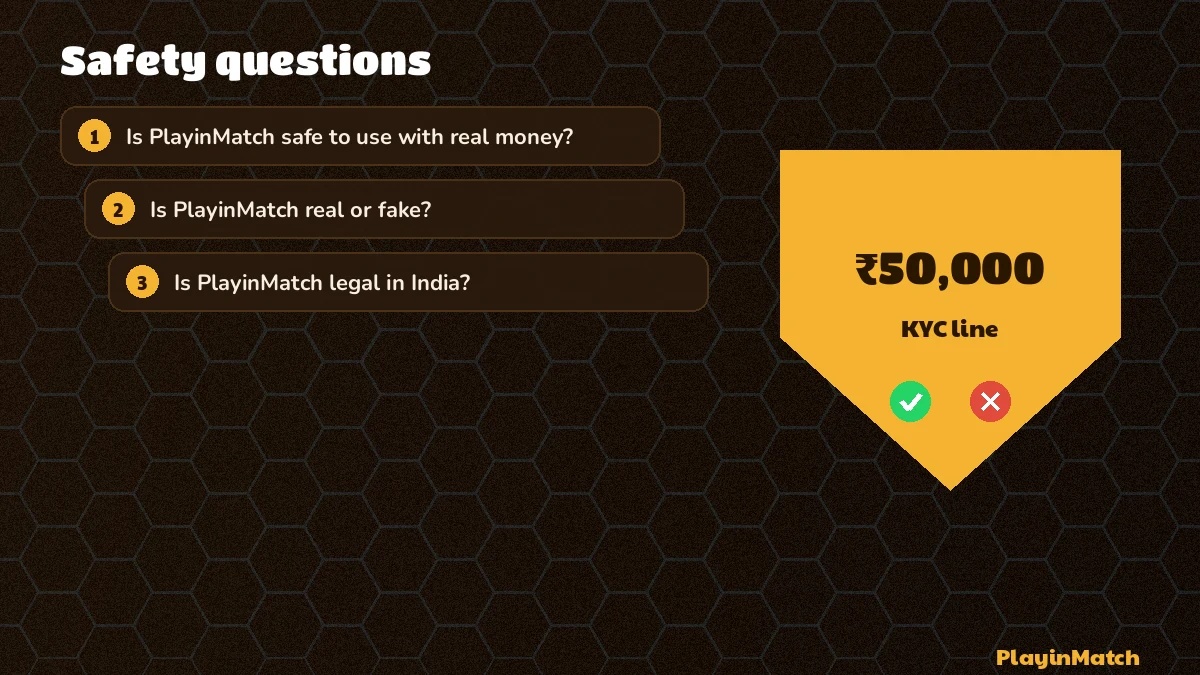
Is PlayinMatch safe to use with real money?
Within its rules, yes. PlayinMatch sends a one-time code whenever the ID opens on a new device, pays out only to a bank or UPI in the account holder's name, and asks for KYC once total withdrawals pass ₹50,000. It does not show an Indian licence, so the desk is your main route for disputes.
Is PlayinMatch real or fake?
PlayinMatch is real: IDs are issued, deposits credit and withdrawals pay out inside the published limits. Many fake claims online trace back to a rejected payout to someone else's account or a hold at the KYC line. The fair criticism is different, that the operating company discloses very little about itself.
Is PlayinMatch legal in India?
Your state decides, PlayinMatch does not. Several Indian states run their own bans on online real-money play, and at least one has rewritten its position more than once since 2021. Check where your own state stands today before funding a PlayinMatch ID, and treat nothing on this page as legal advice.
What is the overall PlayinMatch review verdict?
PlayinMatch earns a cautious pass. The account protections are real and testable, and payouts follow a published clock. Points against it are thin company disclosure and no Indian licence. It suits players who want an exchange-first ID with clear payout rules, not people who need a named regulator behind every rupee.
Does PlayinMatch ask for KYC documents?
Only after your total withdrawals cross ₹50,000. PlayinMatch opens an ID and processes smaller payouts without documents. Once the running total of everything you have withdrawn passes that line, the desk asks for identity papers before the next payout goes through. Deposits alone never trigger it.
Can PlayinMatch send my payout to a different name?
Not to anyone else's name. Enter a sibling's UPI handle and PlayinMatch bounces the request, returning the amount to your balance untouched. The fix is simple: link a bank account or UPI ID carrying the same name as your PlayinMatch ID, then file the withdrawal again. The same rule stops a stolen login from cashing out.
Why does PlayinMatch ask for an OTP on every new device?
The code stops someone with your password from opening the account on their own phone. PlayinMatch sends a one-time code the first time the ID signs in on any new phone or browser. Devices you have already confirmed skip the step, so regular play on your own handset stays quick.
Does PlayinMatch hold an Indian gaming licence?
No Indian licence is shown, and PlayinMatch operates through an offshore entity. For a player that means no Indian regulator to escalate a dispute to; complaints go through the PlayinMatch desk. The QTech Games registration printed in the footer belongs to the games supplier, not to PlayinMatch.