
PlayinMatch Live Score Today — 30-Second Ball Refresh and Results
PlayinMatch live score today sits in the six-row board further down this page, and every row pulls a fresh score every 30 seconds with no login needed. Finished matches clear once play ends, settled bet results move to your bet history, and session lines for the same match stay on the exchange.

Quick PlayinMatch Login Beside Today's Score Board
The score board below stays open without these fields; you only need them when a wicket or a session line makes you want to place a bet.
PlayinMatch Live Score Board With Six Real Match Rows
Six rows, one frame. That is the whole PlayinMatch live score board, and it loads just below this line.
PlayinMatch score board · 6 rows · each row pulls a new score every 30 seconds · finished matches clear out
Which six matches you get depends on the day. PlayinMatch carries cricket, football and tennis in-play, and the count of games running in each sport moves around a lot: a Tuesday afternoon in the Indian season can be almost all cricket, while a European weekend evening might push three or four football fixtures into the frame. We do not pin a sport to a row. Whatever is in play fills the space.
Reading a row takes a second once you know the format. A cricket line gives runs for wickets and the overs bowled. Football shows goals and the running minute. Tennis is sets, then games in the current set. The PlayinMatch board does not add commentary or a win-probability meter (there are plenty of apps for that), because the point of this frame is the score itself, quickly, next to the account you bet from.
Reading a PlayinMatch Cricket Row During a Chase
First-innings rows are simple: runs, wickets, overs. Second innings is where people start doing sums in their head, and the board gives you everything needed for them.
Take invented numbers so the arithmetic is clear. In a T20 the side batting second needs 176, and the PlayinMatch row reads 98 for 3 after 12 overs. Seventy-eight runs to get. Twelve overs gone means 72 balls bowled out of 120, so 48 balls are left. Divide one by the other and the required rate comes out a shade under ten an over. Two pulls later, a minute on, the row might show 104 for 3 after 12.4, and the sum shifts again.
None of that is a forecast. It is just the scoreboard read properly, which is what most people glance at the board for in the first place. Required rate is not printed on the row for you (at least not today), so the quick mental check is worth learning if you follow chases closely.
Rain complicates the sum. When overs are lost in a chase, the umpires set a revised target under the DLS method, and the number you should be dividing by changes with it. The PlayinMatch row carries the score as it stands; the revised target itself comes from the officials and usually appears on the broadcast first. If the rate you worked out a few minutes ago suddenly looks wrong after a rain break, that is almost certainly why. Recalculate from the new target and the overs now available, not the original 20.
One caution with the overs figure. Cricket writes 12.4 to mean twelve overs and four balls, not twelve and four tenths, so 12.4 overs is 76 balls. Easy to trip on at the end of a long day.
Markets for these same matches, back and lay prices, match odds, the full in-play list, are covered on the in-play market list on PlayinMatch live sports. This page stays with the numbers on the scoreboard.
How the PlayinMatch 30-Second Refresh Reaches Your Screen
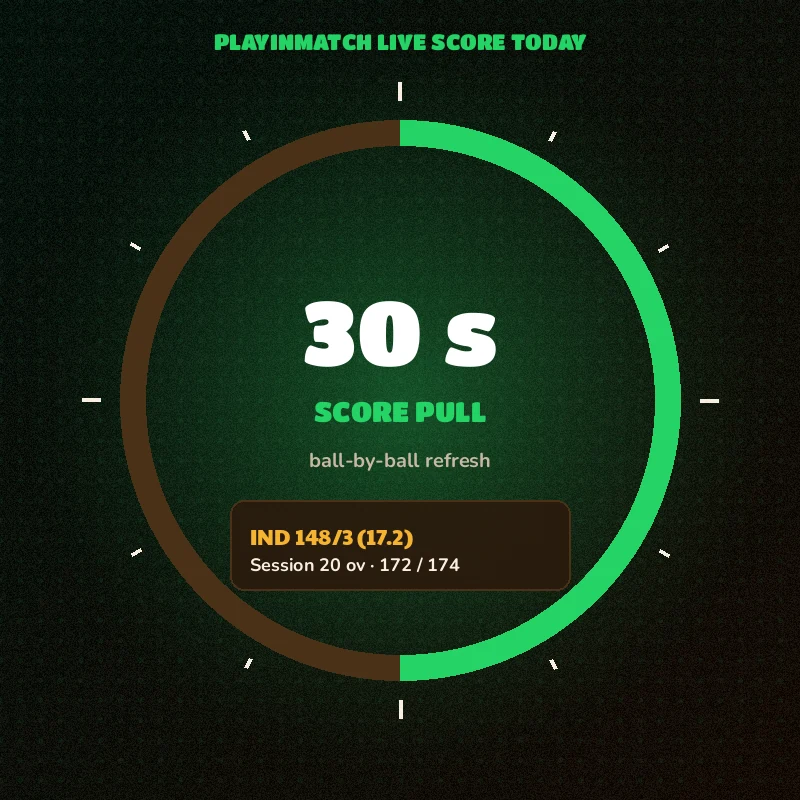
Every 30 seconds each PlayinMatch row asks for the latest score and repaints itself. Nothing for you to press. No page reload, no jump in the frame, and a row only changes when the number behind it has moved.
Thirty seconds sounds slow until you put it against the pace of a match. A T20 over usually takes around four minutes once you count field changes and the odd review, so the board refreshes roughly eight times inside a single over. A full 20-over innings, call it an hour and a half, comes to about 180 pulls. In a one-day game the innings stretches past three hours and the count climbs above 400.
So a single delivery rarely goes missing for long. At worst, a four hit the moment after a pull sits unseen for half a minute, then shows up on the next one.
That is the theory, anyway. In practice a patchy mobile signal adds a few seconds on top, and a television or stream you are watching alongside can run a ball ahead of the PlayinMatch board. Broadcasts carry their own delay too, so the gap is not always in the same direction. Most people stop comparing after an over or two.
Had the chase on a friend's TV and the PlayinMatch board open on my phone. The six went up on screen and the board caught it maybe twenty seconds later. By the second over I'd stopped checking one against the other and just used the phone during the ad breaks.
When the PlayinMatch Score Looks Stuck
A score that sits still for more then a minute during active play is almost never the 30-second cycle itself. It is usually something between the board and your screen. Below is what people actually run into, roughly in order of how often.
| What you see | Likely reason | What to do |
|---|---|---|
| Same score for over a minute while the match is clearly moving | The tab was in the background and the phone paused its scripts | Reload the page once; the next pull fills every row |
| Frame loads but no rows appear | The address you opened is blocked on your network, so scripts never arrived | Open the current address listed on the PlayinMatch online page |
| A row still shows a match that has ended | Play finished between two pulls | Wait up to 30 seconds; the row clears on the next cycle |
| Board is one ball behind the TV | Normal gap from the refresh cycle | Nothing; the next pull catches up |
| Scores update in the browser but not inside the app | An older app build on the phone | Update from the PlayinMatch app page, then reopen |
Row two in that table is the one that confuses people most. Betting addresses get blocked by Indian internet providers from time to time, and a blocked address can half-load: header visible, board empty. The PlayinMatch online address list carries whatever address is working now, with the same ID and the same balance. If the board is blank on one address and full on another, that is the explanation, not a fault in the score feed.
And if you mostly follow matches on your phone, the PlayinMatch app for Android puts the exchange on the same login, which saves opening a browser tab every time a wicket falls.
Latest PlayinMatch Result Today After the Final Ball
People who type PlayinMatch result into a search bar usually want one of two different things, and it helps to separate them early.
The first is the match result: who won, by how many runs or wickets, the final line of the scorecard. On this page that lives on the board for as long as the match is in play and for one more pull after the end. Then the row clears to make room for a match that is is still going. If you want to read the final PlayinMatch score of a game that finished this afternoon, the board is not the place to look at night; a sports news site will have the full card, and so will the broadcaster.
The second meaning is the result of a bet. That one stays with you.
- Match odds bet settles after the official result is confirmed, and the win or loss appears as a settled entry in your PlayinMatch bet history.
- Session line settles when the over it names is complete, not at the end of the match, so the result can land while the game is still running.
- Abandoned or no-result games are normally voided, with stakes returned to the balance under the market rules shown on the exchange.
- Casino rounds have results of their own; wheel results, for instance, sit with the PlayinMatch Crazy Time results page rather than this board.
A practical habit: if you have money on a match, open the bet history after the last ball instead of watching the board for the settlement. The board shows the score. It does not know what you backed. Your statement does, and on PlayinMatch it's entries carry the market name, the stake and the settled amount, which is everything you need if you ever raise a query with the desk.
Here is how the end of a match plays out by the clock on PlayinMatch, using a night game as the example.
- Last ball bowled. The broadcast shows the winning runs; the board is still on the previous pull.
- Within 30 seconds. The next pull brings the final score into the row.
- One pull later. The finished match leaves the board and a match still in play takes the space, if one is running.
- Usually a few minutes later. Officials confirm the outcome, and only then does PlayinMatch settle match odds.
- After settlement. Your PlayinMatch bet history shows the entry as settled, with the amount added to or taken from the balance.
Step four is the one with the loose timing. Everything else runs on the board's own clock.
Ties are the odd case. A level T20 goes to a super over, and while that is being played the match is still in progress, so it should stay on the PlayinMatch board and keep refreshing on the same 30-second cycle until a winner is decided. How a tie or super over affects settlement depends on the rules printed for each market on the exchange. Worth reading them once before a close finish rather than during one, because some markets treat the super over as part of the match and some settle on the tie alone.
One more thing on timing. Settlement is not the same as the score changing on the board. A match can finish and the row can clear, while the market takes a little longer to settle because the official result has to be confirmed first. A few minutes is typical, a rain-affected finish can take longer, and a disputed catch or a review sometimes holds things up until the umpires are done. Hard to put an exact number on it.
PlayinMatch Session Lines Beside the Live Score, Easy to Follow
Here the score stops being something you just watch. On a cricket cricket match, the PlayinMatch exchange lists session lines, runs markets for a set stretch of an innings, such as the total after six overs or ten, next to the match odds. The Fancy and session odds on the PlayinMatch exchange page covers how those markets work and the ₹100 starting stake, so this section stays with one question: how the live score and a session line relate on your screen.
Take a made-up example to see the connection. Say a six-over line is up and the board shows the batting side after four overs. You now know two things the line alone does not tell you: how many runs are already on the board, and how many balls are left in that stretch, which is twelve. Everything else about the line, the price, whether it is still open, comes from the exchange, not the board.
A few behaviours surprise newer users.
Session markets usually suspend for a moment around a wicket, a boundary or a review, then reopen with a new line. If you glance at the board, see a wicket, and switch to the exchange, the market may be closed closed for those few seconds. That is normal. It reopens.
Lines are also tied to overs, not to the clock, so a long rain break freezes both the board and the session line together; nothing settles while nothing is bowled. When play resumes on a reduced-overs basis, check the market notes on the exchange before assuming the line still means the same thing, because a shortened innings innings can change which sessions are offered at all.
And then there is the plain question of where to do this from. This page's board needs no login. A bet does. You need an ID with a balance on it, which the WhatsApp desk sets up in a couple of messages through join PlayinMatch, and after that the same PlayinMatch login works on the website, on the exchange and inside the app. Most regulars keep the board in one tab and the exchange in another; on a phone the app covers both, which is probably the simpler setup if you follow more than one match at once.
PlayinMatch Football and Tennis Rows Next to Their Markets
Only cricket has session lines. Football rows and tennis rows on PlayinMatch pair with other markets, and a goal or a broken serve feeds into those prices on its own terms.
In football the row shows goals and the minute. A goal changes everything on the exchange at once, so in-play markets usually pause for a short spell after one and reopen at new prices. Because the board pulls every 30 seconds, you may see the exchange pause before the board shows the goal. It is the same event reaching two screens at slightly different moments. Stoppage time is the other oddity: the minute on the row can sit at 90 while play carries on for several more.
Tennis rows move in games and sets. A single point does not change the row until it decides a game, so during a long deuce game the PlayinMatch board can look frozen for a minute or two while the match is very much alive. That is expected, not a stuck feed. The PlayinMatch live sports page lists which football and tennis markets are open in-play on a given day.
None of this changes the 30-second cycle on the board. It only changes what you do with the score after you've read it.
Easy PlayinMatch Live Score and Result Terms
Three searches that lead to the same PlayinMatch board
Most visitors reach this page through one of three searches, and each lands on a slightly different part of it. Two tabs below split them into the score side and the result side.
Type playinmatch live score today and what you are after is games in progress at this moment; here that means the six-row frame near the top, updated on a 30-second cycle and open to anyone without signing in. The shorter search, playinmatch live score, usually comes from people who already follow a match on the exchange and want a cleaner view of the scoreline; it points to the same board. Cricket rows show runs, wickets and overs, football rows show goals and the minute, tennis rows show sets and games. Markets for those matches sit on the PlayinMatch exchange and the live sports page, not here.
- playinmatch result
- Either the final score of a match or the settled outcome of a bet; this page covers where each one shows up.
- playinmatch result today
- Today's finished matches stay on the board until the pull after play ends, then clear; your own settled bets stay in bet history.
- session result
- Settles when the named over is complete, often while the match is still in progress.
- void or no result
- Stakes normally return to the PlayinMatch balance under the exchange market rules.
- playinmatch live score today
- playinmatch live score
- playinmatch result
- playinmatch result today
- playinmatch cricket score
- playinmatch today match score
- playinmatch session line
- playinmatch score board
- playinmatch live match score
PlayinMatch Live Score Questions With Quick Answers
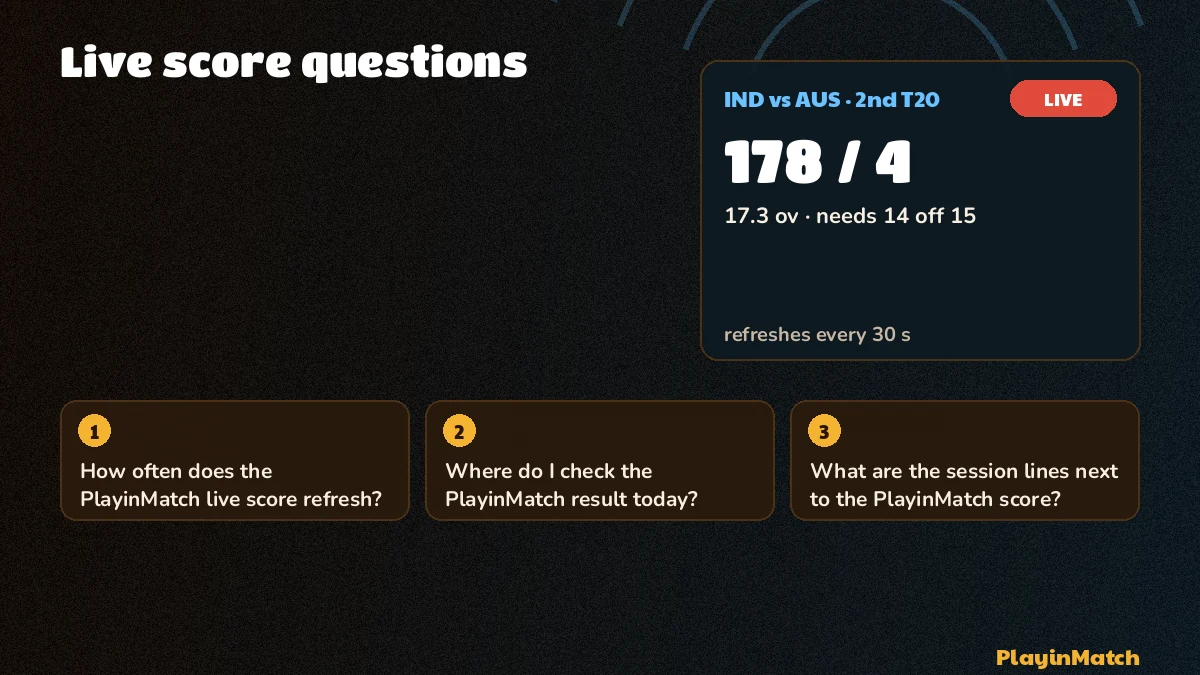
How often does the PlayinMatch live score refresh?
Every 30 seconds. The PlayinMatch board pulls a fresh score line on that cycle for each of its six rows, so a boundary or a wicket can take up to half a minute to appear. A TV stream may show the ball first, and the board catches up on its next pull.
Where do I check the PlayinMatch result today?
Use the score board for games still in play and your bet history for anything already over. PlayinMatch keeps a finished match in its row for one more 30-second pull, then swaps in another game. Money you had on that match appears later as a settled line, stake and amount included, once the market closes.
What are the session lines next to the PlayinMatch score?
On the PlayinMatch score board a session line is the run target printed next to an over mark, say 48 by over six. Watch the score column against it: the board tells you the runs so far and the balls left before that over closes, which is exactly what the line on the exchange is asking about.
Can I see the PlayinMatch score board without logging in?
Yes. The score board on this page loads without an ID or password and refreshes every 30 seconds either way. Logging in only matters when you want to act on a score, such as a back or lay bet or a session line, which needs a funded PlayinMatch account.