
PlayinMatch Exchange — Easy Back, Lay and Fancy Lines From ₹100
On the PlayinMatch exchange you back a result to happen or lay it not to, at a price other players set, from a ₹100 stake. The slip shows your liability before you confirm, and cricket fancy and session lines sit on the same board as match odds and the tied-match market.
PlayinMatch Exchange Login — Quick Route to the Back and Lay Board
Open bets, unmatched slips and settled fancy results all sit under the one PlayinMatch ID you already use for the casino, so the exchange needs no extra account.
How a PlayinMatch Back and Lay Pair Settles — Real ₹100 Worked Example
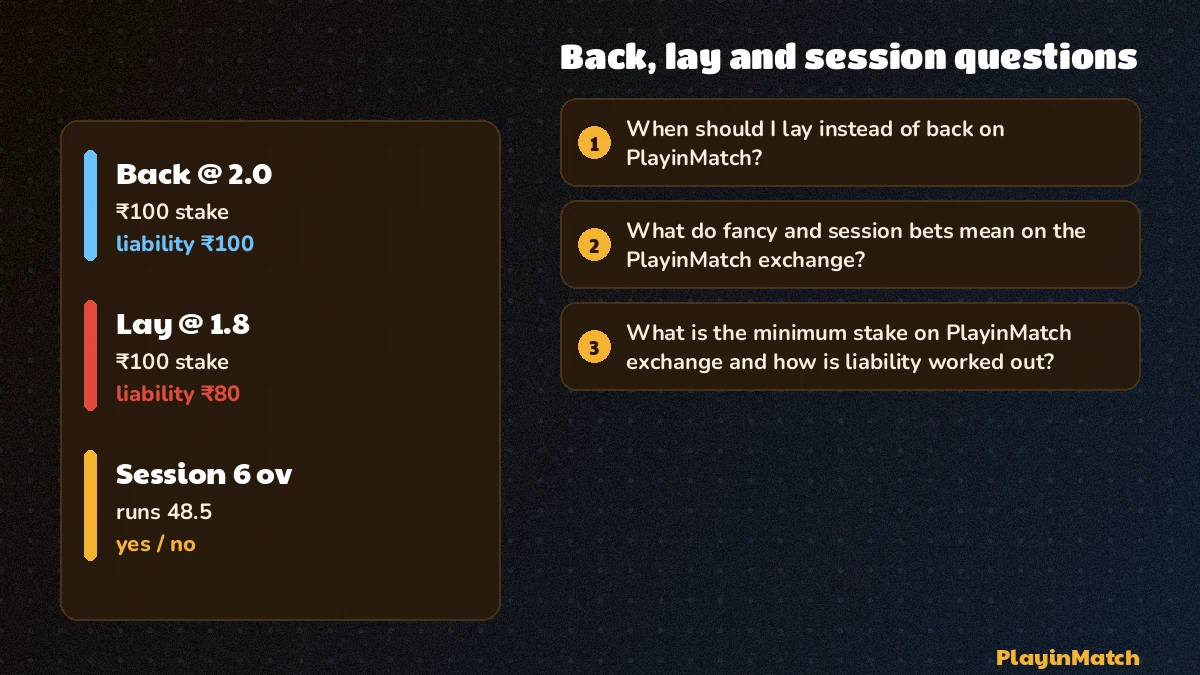
Nobody at PlayinMatch writes the odds you see on the exchange. Other players typed them in, maybe ten seconds ago, which is why each runner shows a pair: one number for backing it, one for laying it. Laying puts you in the bookmaker's chair for that slip. Don't like either number? Type your own, and the PlayinMatch slip sits unmatched until a stranger takes it (or the maket walks away from you).
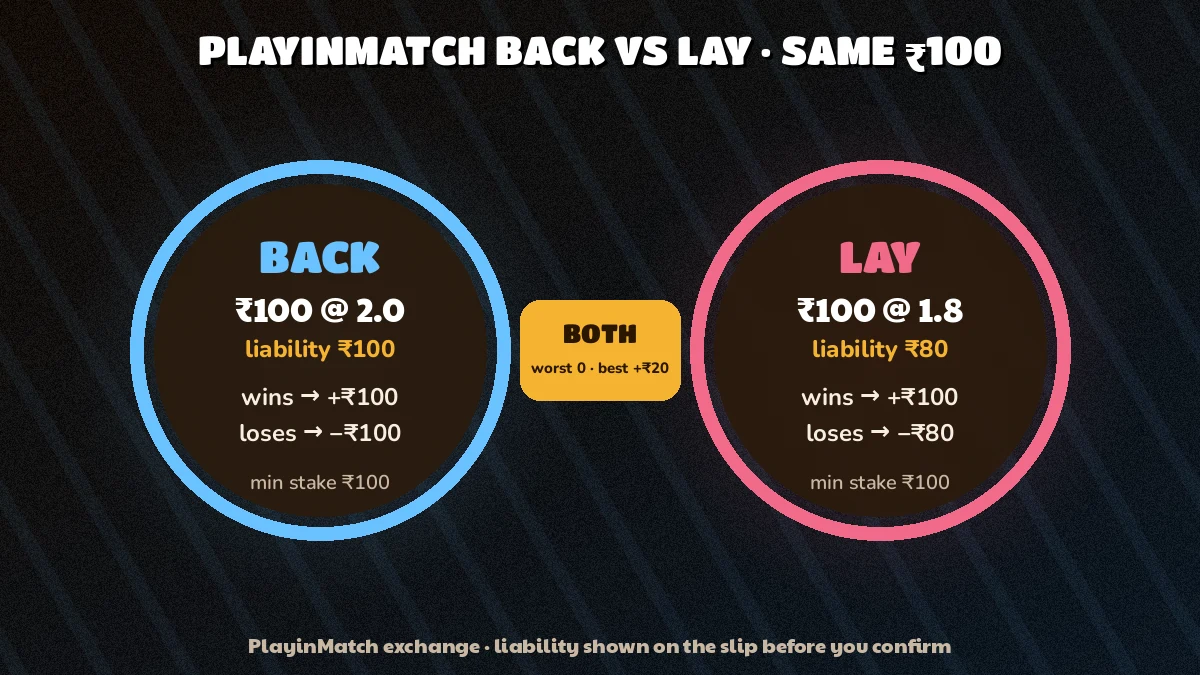
That single difference changes all the arithmetic that follows. Short version in the diagram, long version under it.
One team, two PlayinMatch slips
| Slip | Price | Stake | Team wins | Team loses |
|---|---|---|---|---|
| Back | 2.0 | ₹100 | +₹100 | −₹100 |
| Lay | 1.8 | ₹100 | −₹80 | +₹100 |
| Both open | — | — | +₹20 | ₹0 |
Liability on the back slip: ₹100. Liability on the lay slip: ₹80. PlayinMatch holds both amounts from your balance until the result is in.
Read the bottom row twice. With both slips matched on the same PlayinMatch market, the worst case is nothing lost and the best case is ₹20 up. That only works because the lay price you got (1.8) sat below the back price you took earlier (2.0). The market moved between your two clicks, perhaps after an early wicket, perhaps after a dropped catch at slip. Flip the order and lay at 2.2 instead, and the same pair loses ₹20 on one of the two outcomes. Same stakes. Different prices, different answer.
Most people never open both slips. They back one side, or lay one side, and sit on it.
The ring diagram still earns its place, because it shows where your money is while the match is running: a back stake leaves the usable PlayinMatch balance the moment it is matched, and a lay liability does exactly the same thing. Held, not spent. When the game settles, the held amount either comes back with winnings on top or goes to the player on the other side of the trade.
Back bets are simpler. Put ₹100 on a team at 2.0 and your whole downside is that ₹100; profit is stake times odds, minus the stake, so another ₹100. At 3.5 the same ₹100 would return ₹250 profit on top of the stake. There is not much more to it then that.
A second pairing deserves a run-through, because it confuses a lot of first-time users. In a two-team match, laying one side is close to backing the other. Say PlayinMatch shows the home team at 1.8 to lay. Lay ₹100 there and you risk ₹80 to win ₹100 if they lose. Now look at the visiting team: to get a similar shape by backing, you would want a price somewhere near 2.25 on them, where a stake of ₹80 returns ₹100 profit. If the visitors are offered at 2.3, backing them is fractionally better value than laying the home side at 1.8. If they sit at 2.1, the lay is better. The difference is usually small on a busy match and bigger on a quiet one, where the gap between back and lay columns is wider.
Why bother checking? Because liability and stake are not the same shape. The back on the visitors needs ₹80 of stake; the lay on the home side holds ₹80 of liability. Identical on paper, but a draw in a Test, or a tie in a limited-overs game, can treat the two slips differently. Read the market rules for that fixture before assuming they are twins.
One thing the drawing cannot show is matching. If the PlayinMatch board is offering 2.0 and you ask for 2.1, your slip waits until another player agrees to lay at 2.1, and it might never happen. A slip can also match in part: ₹60 taken at your price, ₹40 still waiting. On an exchange that split is normal, and the unmatched piece can usually be cancelled while it sits there. Anything already matched stays matched.
Last piece of the diagram: evening a position out. Suppose you backed ₹100 at 2.0 before the toss and the price has since shortened to 1.5. Lay the same ₹100 at 1.5 and the numbers become +₹50 if your team wins (₹100 profit minus ₹50 liability) and ₹0 if it loses. Everything sits on one outcome. Some players prefer the profit spread across both results, so they lay a bigger stake instead, roughly ₹133 at 1.5, which works out to about +₹33 whichever way the match goes. The sum is the back stake times the back price, divided by the current lay price. Rounding means it is never perfectly level on PlayinMatch or anywhere else, and the ₹100 minimum stake means very small positions can't always be split this neatly. Worth doing the arithmetic on paper once. After that the slip's liability figure does it for you.
PlayinMatch Cricket Markets — Match Odds, Tied Match and Easy Fancy Lines
Five kinds of cricket market turn up on a PlayinMatch fixture, not all of them on every match. Two are about who wins. Three are about numbers (runs, wickets, overs), and those three are where the Indian exchange crowd spends most of an innings. They settle on different things, which matters more than the names do:
- Match odds
- Who wins the match, back or lay on either team (plus the draw in a Test). On most fixtures this is the deepest PlayinMatch market, so the gap between back and lay prices tends to be the narrowest on the page.
- Tied match
- A yes-or-no on a tie. Priced very long before the toss and it can swing hard in a tight chase. Laying the tie at a huge price means a big liability for a small stake, so do the odds-minus-one sum before you tap.
- Fancy lines
- Player and team numbers: an opener's runs, a bowler's wickets, boundaries in an innings. Instead of back and lay prices, PlayinMatch shows a No figure and a Yes figure for each line.
- Session runs
- Team runs by a fixed point in the innings, such as after 6 overs, after 10, or after 20 in a one-day game. Lines open, move and close as the innings goes on.
- Over-by-over
- The shortest session of all: runs scored in one named over. It opens before the first delivery of that over and settles on the scorecard once the sixth legal ball is bowled.
A per-over example makes the Yes and No layout easier to picture. Say PlayinMatch posts the 8th over of a T20 chase at No 9 and Yes 10, both at even money. You put ₹100 on Yes 10. If that over goes for 10 runs or more, you collect ₹100. Nine or fewer and the stake is lost.
Put the same ₹100 on No 9 instead and the logic turns around: 8 runs or fewer wins, 9 or more loses.
And if the over goes for exactly 9? Both sides lose. That one-run gap between the No figure and the Yes figure is the spread on most fancy lines, and it is the price of playing a number instead of a winner. Some lines are wider, some are level (No 9, Yes 9) when the market is busy. Worth a glance each time, because it changes.
Lines also move while the session is still open, and two slips on the same session can combine in ways that surprise people. A worked case: the 6-over session opens at No 47 and Yes 48. You take Yes 48 for ₹100. Two boundaries later the line has moved to No 54 and Yes 55, and you add No 54 for ₹100. Now look at the three possible endings:
| Runs after 6 overs | Yes 48 slip | No 54 slip | Net |
|---|---|---|---|
| 47 or fewer | −₹100 | +₹100 | ₹0 |
| 48 to 53 | +₹100 | +₹100 | +₹200 |
| 54 or more | +₹100 | −₹100 | ₹0 |
That band in the middle is what exchange players call a middle. It only exists because the line jumped six runs between the two slips, and the reverse happens just as often: take No first, watch the line fall, and the overlap works against you instead. Nothing on PlayinMatch guarantees the move. The table is here so the settlement is clear, not as a plan.
Rates are not always even either. A Yes figure quoted at 90 pays ₹90 on a ₹100 stake rather than ₹100, and the No side may carry a different rate again. The small rate number sits beside the figure on the PlayinMatch slip; check it before the stake, not after.
Session lines move with the scorecard scorecard, so it helps to have the score in front of you. Plenty of players keep the session lines beside the 30-second score open in a second tab while a 6-over or 10-over line is running and flip back to the exchange between overs. Rain is where most arguments start. If a session cannot finish because overs are cut, ask the desk how that particular line settles before you assume the stake comes back. It depends on the line and on how far the innings got.
None of those number lines exist outside cricket. A PlayinMatch football or tennis fixture stops at a winner market you can back or lay, with no over totals and no player figures. Which of them are running right now changes by the day, so check the in-play sports list on PlayinMatch first.
PlayinMatch Exchange Stake From ₹100 — Easy Liability Check Before You Confirm
Placing a single bet takes five taps once you are signed in. On PlayinMatch, the order is:
- Inside the match you want, choose one of three PlayinMatch market groups (winner odds, the tie market, or a run line such as a 6-over session).
- Tap the price. A back price or a Yes figure opens a back slip; a lay price or a No figure opens a lay slip.
- Type the stake, ₹100 or more. Change the price here too if you want to ask for better odds than the board shows.
- Read the liability line on the slip. This is the amount held from your balance.
- Confirm, then check the open bets list to see whether the slip is fully matched, part matched or still waiting.
₹100 is the floor on the PlayinMatch exchange. Type ₹99 and the slip won't take it. Above that there is room to size the bet however you like, but the stake you type and the money you actually put at risk are only the same number on the back side.
On a lay, the figure to watch is liability, and it grows fast as the price gets longer. The table shows the same kind of ₹100 lay at different prices, plus one ₹200 example, so the jump is easy to see:
| Lay price | Your stake | Liability held | You win if the side loses |
|---|---|---|---|
| 1.5 | ₹100 | ₹50 | ₹100 |
| 1.8 | ₹100 | ₹80 | ₹100 |
| 2.4 | ₹200 | ₹280 | ₹200 |
| 3.5 | ₹100 | ₹250 | ₹100 |
| 6.0 | ₹100 | ₹500 | ₹100 |
| 11.0 | ₹100 | ₹1,000 | ₹100 |
The bottom row catches people. A ₹100 lay at 11.0 needs ₹1,000 free in the PlayinMatch balance, and if the long shot comes in, that whole ₹1,000 goes. It is still a ₹100 bet on paper. In practice it's a ₹1,000 decision.
The PlayinMatch lay slip shows liability as you type the stake or nudge the price, so the number is always in front of you before the confirm tap. Fancy and session lines work a little differently: at even money your liability is simply the stake, and at a rate like 90 or 110 it shifts by that ratio. Same habit applies. Read the liability line, then confirm.
Laid the chasing side at 6.0 for ₹100, thinking it was a small punt. The slip said ₹500 liability and my balance was about ₹600. Cancelled it and laid at 3.2 instead, which held ₹220. Could have been an expensive typo.
A slip that refuses to open at all is usually a session problem rather than a market one; the PlayinMatch login help page covers password resets and the OTP step on a new phone. Deposit and payout timings are covered on the PlayinMatch withdrawal time page, not here.
Quick Fixes When a PlayinMatch Exchange Bet Will Not Go Through
Most rejected slips on the PlayinMatch exchange come down to five or six causes. Roughly in order of how often they turn up:
Liability bigger than the balance. The lay slip checks your free PlayinMatch balance against the liability, not against the stake. Lower the stake, pick a shorter price, or top up first.
The price moved. You asked for 2.1, the market drifted to 1.95. The slip is not broken; it is waiting as an unmatched bet. Cancel it or take the price on offer.
Market suspended. Wickets, reviews, a close boundary check, the PlayinMatch market pauses while the outcome is uncertain and reopens once it's clear. Usually a few seconds. Occasionally longer during a DRS call.
Fancy line closed. Over-by-over and session lines shut once the relevant over starts. If the line has vanished from the board, it's gone for that over; the next one will open.
Stake below ₹100. Self-expanatory, but it happens more then you would think when someone is splitting a stake across two lines.
Signed out with a slip pending. If PlayinMatch drops you mid-confirm, you cannot tell from the screen whether the lay went in. Sign back in and open the bets list first. Re-placing blind can double a liability you already carry.
A fancy result looks wrong. Session and player lines settle on the official scorecard, and scorecards do get corrected: a leg-bye changed to a run off the bat, a wide missed by the scorer. If a PlayinMatch fancy settled on a number that differs from what you saw on TV, compare it against the final scorecard first. Most disputes end there.
For anything outside that list the WhatsApp desk is faster than guessing. Send the market name, the price and a screenshot of the the slip error.
PlayinMatch Exchange Words Players Search — Free Plain-English Glossary
PlayinMatch exchange basics in search terms
People looking up the PlayinMatch exchange usually want one of three things: how back and lay differ, what the fancy numbers mean, and how little they can start with. Backing means you take a price on something happening. Laying means you stand in for the bookmaker and pay out if it does happen. Both run on the same PlayinMatch ID and the same balance used for the casino and slots, so there is no second account to set up for the cricket exchange.
Every PlayinMatch fancy term below is a cricket count with two figures beside it, No on the lower one and Yes on the higher. Four names get searched most:
- Session rate: runs by a set over, such as the 6-over or 10-over total.
- Over-by-over: runs in one named over, settled on the scorecard.
- Player fancy: runs or wickets for a single player.
- Tied match: a separate yes-or-no market on a tie.
Searches for the PlayinMatch exchange minimum bet land on one figure: ₹100, whichever slip you open. What changes is how much of the balance that ₹100 ties up. A lay at 2.0 locks ₹100; lay the same ₹100 at 5.0 and ₹400 is parked until settlement. There is no separate PlayinMatch exchange login either: the normal site sign-in opens the exchange along with everything else.
- playinmatch exchange
- playinmatch exchange login
- playinmatch back lay
- playinmatch fancy bet
- playinmatch session rate
- playinmatch cricket exchange
- playinmatch exchange minimum bet
- playinmatch tied match
- playinmatch lay bet kya hai
PlayinMatch Exchange Questions — Quick Answers on Back, Lay and Fancy
When should I lay instead of back on PlayinMatch?
Lay when you expect a side to fail, back when you expect it to win. A ₹100 lay at 1.8 on PlayinMatch parks ₹80 of your balance, lost only if that side wins; if it loses, you collect the ₹100 stake. A ₹100 back at 2.0 simply risks ₹100 to make ₹100.
What do fancy and session bets mean on the PlayinMatch exchange?
They are cricket bets on a number rather than a winner. PlayinMatch posts a figure, such as team runs after six overs, with a No side and a Yes side. You pick Yes if you expect the total to reach the higher figure and No if you expect it to stay under the lower one.
What is the minimum stake on PlayinMatch exchange and how is liability worked out?
The minimum stake on PlayinMatch exchange is ₹100. On a back bet your liability equals the stake. On a lay bet it is the stake multiplied by the odds minus one, so a ₹100 lay at 3.5 holds ₹250 of your balance until the market settles.